
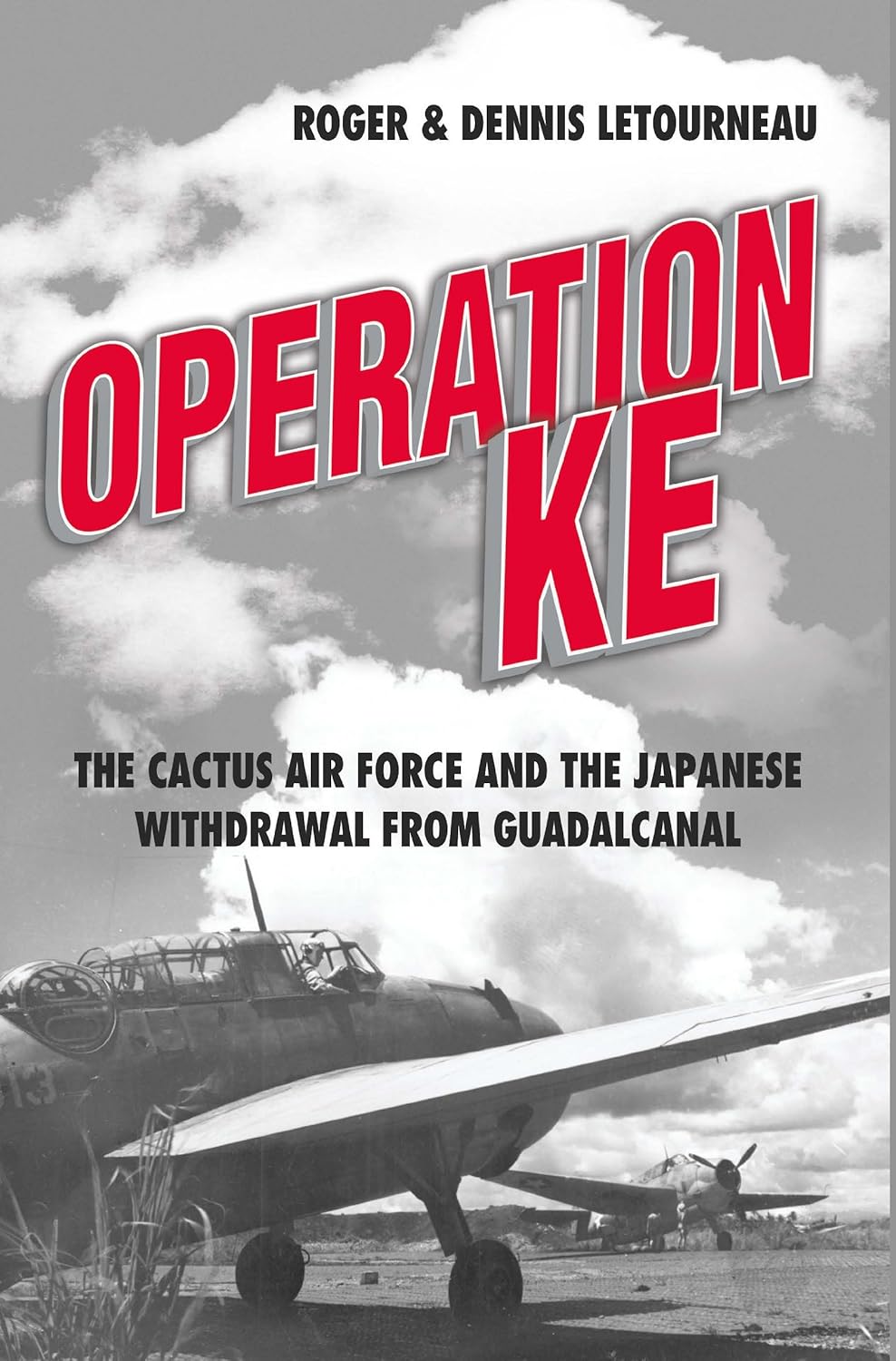
Operation KE: The Cactus Air Force and the Japanese Withdrawal from Guadalcanal
Product details
| Management number | 233370418 | Release Date | 2026/06/27 | List Price | US$11.05 | Model Number | 233370418 | ||
|---|---|---|---|---|---|---|---|---|---|
| Category | |||||||||
Operation KE explores the air combat that attended the Japanese evacuation of Guadalcanal in early 1943 —a topic which has hitherto received very little attention. Operation KE was successful largely because Japanese strategic planning and tactical execution was basically sound. The traditional view holds that the Japanese got away with the initiative largely because the Americans let them; the US Pacific high command felt it was not worth the effort to try and stop them. Letourneau contends that this was not entirely the case. He argues that the Cactus Air Force and Guadalcanal-based naval units did their best to disrupt the evacuation, still believing that the Tokyo Express was bringing reinforcements and supplies to the 17th Army. Other US forces in the South Pacific did make a half-hearted and questionably-executed attempt to stop the Japanese, but were bluffed into adopting a ""wait-and-see"" posture. Operation KE focuses on the air war fought between the Cactus and US 13th Air Forces on the one hand and the Japanese Navy and Army Air Forces on the other, from mid-December, 1942 to mid-February, 1943. The book scrutinizes the US air strikes against the six KE-related Tokyo Express destroyer runs, plus related air strikes against the Japanese merchant marine, as well as air and naval base-suppression missions undertaken by both sides, to determine what actually happened in order to analyze why the Japanese evacuation succeeded and why Cactus failed to stop it. Background chapters attempt to assess the respective states of readiness of the Japanese and US air arms in the South Pacific to support on the one hand and counter on the other the execution of Operation KE. The central portion of the book narrates in some detail what actually occurred in the air and at sea -—including air strikes, fighter sweeps, base suppression missions, and naval sorties -—during the crucial prelude to and the actual playing out of the interrelated events that comprised the evacuation operation. Concluding chapters analyze, on both strategic and tactical levels, the Japanese planning and execution of Operation KE, and Cactus' initiatives to interdict KE's successful prosecution. The authors conclude that both the Japanese and the American states of readiness on the eve of Operation KE suffered in such matters as optimizing both resources and operating procedures, and combating a hostile environment. Consequently, both combatants were somewhat handicapped in their abilities respectively to carry out and contest Operation KE. The author contends that the Japanese developed a reasonably sound strategy that exploited those methods and tools of war then in use in the South Pacific; to achieve success, they maximized their own strengths while taking advantage of their adversary's limitations. Contrary to the traditional view, the authors are of the opinion that Japanese utilization of their newly-built airstrip at Munda in the Central Solomons played an important role in the success of Operation KE, which was in keeping with the long-range intention of developing Munda and Vila airstrips as major forward airbases to defend against any Allied push toward Rabaul through the Solomons. The U.S., on the other hand, by consistently misreading Japanese intent regarding Operation KE and pursuing a cautious offensive strategy, blunted the tactical impact of their initiatives to counter the evacuation. Several imprudent tactical decisions and a misallocation of resources further diluted the strength of US efforts." Read more
| ASIN | B009WW5CG4 |
|---|---|
| XRay | Not Enabled |
| ISBN13 | 978-1612511795 |
| Language | English |
| File size | 5.3 MB |
| Page Flip | Enabled |
| Publisher | Naval Institute Press |
| Word Wise | Enabled |
| Print length | 418 pages |
| Accessibility | Learn more |
| Screen Reader | Supported |
| Publication date | November 15, 2012 |
| Enhanced typesetting | Enabled |
Bestseller ranking
Budgetary & Cost


Customers who viewed this product also viewed
World War II



Correction of product information
If you notice any omissions or errors in the product information on this page, please use the correction request form below.
Correction Request Form